The Spicy Story of Samyang Foods: From Humble Beginnings to Global Fame

Samyang Foods is one of South Korea’s oldest and most storied food companies, best known today for its ultra-hot Buldak (Hot Chicken Flavour) instant ramen. Its journey begins in 1961, when founder Chun Joong-yoon (also romanized Jeon Jung-yoon) left a career as an insurance executive to tackle Korea’s post-war food shortage. Inspired by seeing people line up for meager U.S. Army base leftovers, Chun believed a cheap, convenient noodle could help feed his hungry countrymen[1]. He named his new venture Samyang Foods (샘양食品), and in 1963 Samyang debuted Korea’s first instant noodle: a simple chicken-flavored ramen packet that sold for just ten cents (less than a cup of coffee)[1][2]. This product, Samyang Ramen, soon became a staple in Korean households, helping lift a generation out of hunger.

Rise to Dominance in the 1970s
In the 1960s and 1970s Samyang Foods exploded in popularity. Under Park Chung-hee’s government, Chun even spiced up the broth at the president’s suggestion, tailoring flavors to local palates[3]. By the 1970s Samyang held a commanding ~65% share of Korea’s noodle market – a remarkable feat in a nation just rebuilding after war[3]. Samyang didn’t stop at ramen. It expanded into dairy, yogurt, snacks and sauces, and even built a large organic farm in the Daegwallyeong plateau to supply ingredients (beef and milk)[4][5]. The company also aimed abroad: in 1984 Samyang opened its first overseas factory in Los Angeles to serve the Korean diaspora in North America[3]. In many ways, Samyang became a second staple of Korea – instant ramen was affordable, portable comfort food through decades of rapid change.

Scandal and Struggle
That dominance was seriously challenged in 1989 by the so‑called “beef fat affair.” An anonymous tip accused Samyang of cooking its noodles in non-food-grade beef tallow[6]. Though the claims were later proven false, the scandal devastated the company’s reputation. Consumers turned away and Samyang’s top food scientists defected to rivals. By the time Samyang was fully exonerated in 1997, the company had racked up massive debts (exacerbated by the 1997 Asian financial crisis) and even shuttered its L.A. plant[6]. For many years Samyang operated in survival mode, doing its bookkeeping by hand and slowly paying off creditors. Its star status had faded as competitors like Nongshim rose in the market.

A New Era and the Birth of Buldak Ramen
The 2000s brought new leadership and ideas. After founder Chun Joong-yoon stepped down (becoming Honorary Chairman in 2010[7]), his son Chun In-jang took the helm – though early side ventures (a noodle shop and burger chain) flopped. In this period, Samyang was still churning out more traditional products (noodles, soups, snacks) but had not had a major breakthrough. That breakthrough arrived in 2012 in the form of “Buldak Bokkeum Myeon” – literally “fire chicken stir-fried noodles” – created under the guidance of Kim Jung-soo, Chun In-jang’s wife. (Kim had joined the company in 1998 to oversee sales and eventually became CEO.) Samyang’s food scientists first brought Kim a very hot noodle prototype and she famously told them to make it even spicier[8]. In April 2012 Samyang launched Hot Chicken Flavor Ramen (Buldak), featuring a thick, fiery red sauce packet and cartoon chicken mascot on the pack. The instant debut was underwhelming – retailers and early consumers said “it was too spicy,” and initial sales were weak[9].
Everything changed in 2014 when viral video challenges put Buldak on the map. A British YouTuber (“the Korean Englishman”) filmed friends and his own father trying the noodles and guzzling milk as relief[10]. Later that year US competitive eater Matt Stonie scarfed 15 packets in a video with over 145 million views[11]. Suddenly, Buldak Ramen was a global internet sensation – the rage of “fire noodle challenges” worldwide. As people across Asia, Europe, and North America sought out the notorious spicy noodles, Samyang’s export sales took off. By 2015, roughly 65–75% of Samyang’s revenue came from overseas markets[12]. In fact, Samyang capitalized on its popularity by forming local sales arms: Samyang Japan (2019), Samyang America (2021) and a China subsidiary (2021)[13]. The company even announced plans to build new factories abroad – a plant in China is under construction (2025) and executives have mentioned reopening a US plant in the future.
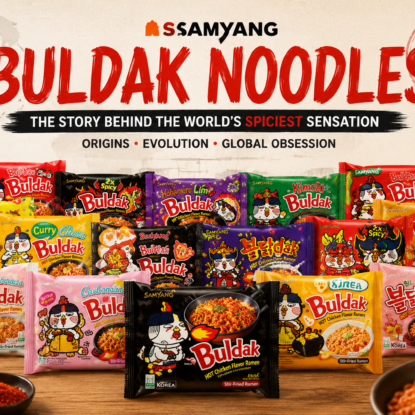
Beyond the Buldak line, Samyang’s best-known products include the original Samyang Ramen (in cup or bag form, chicken or beef flavor), and various derivatives of the Hot Chicken ramen: 2X Spicy, 3X Spicy, Cheese Buldak (with a creamy cheese packet), and the later Carbonara Buldak (pink sauce), among others[14]. (It also makes other instant noodles like Kimchi Ramen and Sutah Ramen, and even frozen noodles.) Collectively, these became the backbone of Samyang’s resurgence. By the early 2020s, Samyang’s Buldak exports had made it one of Korea’s top noodle exporters – in 2024 the company reported record overseas revenue of about ₩1.33 trillion (roughly $1.0 billion)[15], a 65% jump from the year before. American sales in particular exploded (127% growth in 2024 alone) after Buldak noodles hit retail chains like Walmart and Costco[16]. Songs, memes and even celebrities fueled the trend: K-pop stars (e.g. BTS’s Jimin) and stars like Cardi B were spotted hunting down Samyang noodles. (For a time, the Carbonara Buldak was so hyped on TikTok that US stores ran out for weeks[17].)

Leadership and Controversies
Behind the scenes, Samyang’s story was not without drama. The family-owned firm follows traditional Korean succession: Chun In-jang led through the 2010s, but major corporate misdeeds shook the company. In 2020 Chun In-jang (the Chairman) and Kim Jung-soo (the CEO) were found guilty of embezzling about $3.7 million of company funds[18]. They had used company money for personal expenses (home remodels, car leases, credit cards) and were prosecuted; Chun went to jail and Kim received a suspended sentence. Both repaid the money[18]. This scandal cast a pall over Buldak’s success for a time, illustrating the pitfalls of unchecked family ownership. (Kim Jung-soo was later pardoned by the government and returned to Samyang’s leadership as CEO in 2021[19].)
Likewise, Samyang was entangled in other industry controversies. In 2012 the Fair Trade Commission fined Samyang (with three rival firms) roughly ₩11.6 billion for colluding on price hikes from 2001–2010[20]. And of course there was the old 1989 beef tallow scandal: Samyang was eventually cleared of wrongdoing in 1997, but by then the damage was done and it lost market dominance[6][21]. Even as recent as 2024, Samyang faced a quirky health scare abroad: Denmark’s food safety agency recalled three of its hottest Buldak products (the 3X Spicy, 2X Spicy, and Hot Chicken Stew variants), citing extremely high capsaicin levels that “pose a risk of acute poisoning”[22]. (Samyang disputed the test results and worked with researchers to clarify the spice content[23].)
Samyang CEO Kim Jung-soo, who is widely credited with the Buldak recipe, has steered the company in the 2010s. After a brief setback in 2020 (embezzlement conviction), she returned to lead Samyang to new heights.

Today: A Global Ramen Powerhouse
Despite past turmoil, Samyang Foods today is thriving on the international stage. The spicy Buldak line remains its signature brand and has broadened to include innovative spin-offs (like “Jjapaguri” and other fusion flavors). Korean media report that by 2024 Buldak ramen drove Samyang’s revenues from ₩224 billion in 2015 to nearly ₩893 billion in 2023[12]. Exports now account for ~75–80% of sales[12][24], and the company is again investing in capacity – finishing a new Miryang plant (2025) and planning the first overseas factory (in China) to meet demand[25]. It has also started branching into related fields, such as health-food products and restaurant chains.
Samyang Foods’ roller-coaster story – from war-torn beginnings to national champion, from scandal-plagued struggles to digital-age revival – reflects the broader arc of Korea’s instant noodle industry. Its most famous product, the fiery Buldak Hot Chicken Ramen, has become a modern cultural export, earning Samyang a cult following among “spicy food challenge” fans worldwide. At the same time, the company remains committed to its founding philosophy of honest, high-quality food (as emphasized by Chun Joong-yoon’s corporate credo)[26]. With nearly 90 years of history (the group it belongs to dates back to 1924) and continued innovation, Samyang Foods aims to keep adding chapters to its spicy saga – one steaming bowl at a time[2][12].

Sources: Historical and corporate details from Samyang Foods’ official site and Korean business news; major reporting from the Los Angeles Times and other media on Samyang’s founding, product launches and viral success[1][27][15]; controversies and sales figures from recent news articles[20][22][12] (citations included). All facts are from reliable news and company sources.
[1] [3] [6] [8] [9] [10] [11] [12] [18] [19] [27] How very spicy noodles saved the Korean ramen pioneer – Los Angeles Times
[2] [4] [5] [7] [13] [14] [26] Samyangfoods | COMPANY | SAMYANG FOOD
https://www.samyangfoods.com/eng/information/company/index.do
[15] [16] [24] [25] Samyang’s overseas sales hit record high as China, U.S. investments pay off
[17] [22] Denmark recalls South Korean firm’s instant noodles for being too spicy | Denmark | The Guardian
[20] FTC fines 4 makers of ramen for price-fixing
[21] Samyang Foods – Wikipedia
https://en.wikipedia.org/wiki/Samyang_Foods
[23] Samyang Foods says Denmark’s Buldak recall based on spice miscalculation