What Is Buldak? The Story Behind the World’s Most Famous Spicy Noodle
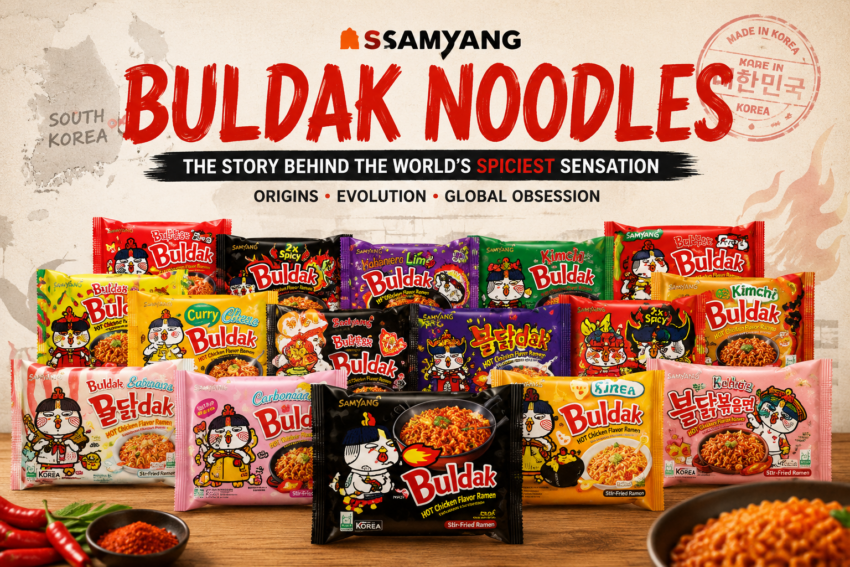
If you’ve ever stared down a black-and-red packet of noodles, felt your palms sweat, and thought “why would anyone do this to themselves” — then you already know Samyang Buldak noodles. They’re the product that turned an entire generation into sweating, teary-eyed content creators, inspired millions of YouTube challenges, and somehow made the world fall head over heels for a noodle that genuinely tries to hurt you.
But how did a small South Korean food company go from fighting post-war hunger in 1961 to selling 8 billion packs of the world’s most famous spicy noodle? The story is wilder — and more delicious — than you’d expect.

What Does “Buldak” Actually Mean?
Let’s start with the basics. Buldak (불닭) is a Korean word made up of two parts: 불 (bul) meaning fire, and 닭 (dak) meaning chicken. Put them together and you get “fire chicken” — which is exactly what it tastes like.
The full product name is 불닭볶음면 (Buldak Bokkeummyeon), which translates to “fire chicken stir-fried noodles”. Unlike your classic ramen that comes swimming in broth, Buldak is a dry, stir-fried style noodle — you drain the water, then coat the thick, chewy noodles in a glossy, aggressively red sauce. It’s punchy, it’s smoky, and it does not apologise for itself.
In South Korea, buldak originally referred to a popular spicy grilled chicken dish that exploded onto the Seoul street food and pub scene in the early 2000s. Think intensely spiced, charred chicken eaten alongside cold beer or soju — the kind of thing you eat even though you know you’ll regret it. Samyang’s genius was turning that concept into an instant noodle.

The Company Behind the Heat: Samyang Foods
To understand Buldak, you first have to understand Samyang Foods — the company that made it.
Samyang Foods was founded on 15 September 1961 by Jeon Jung-yoon (Chun Joong-yoon), a former insurance executive who was so troubled by the sight of hungry citizens queuing for thin soup in post-Korean War Seoul that he left the financial industry entirely to get into food. The company’s founding philosophy — “Food sufficiency leads to world peace” — still sits on its corporate website today.
In 1963, after licensing noodle-making technology from Japan, Samyang launched South Korea’s very first instant ramen. Affordable, easy to cook, and instantly popular, Samyang Ramen became a national staple at a time when the country desperately needed one. For decades, Samyang was the noodle brand in Korea — a household name in every sense.
But by the 1990s and 2000s, the company had lost its edge. A rival brand had overtaken it in market share, and a damaging (and ultimately unfounded) food scandal in 1989 had knocked consumer confidence. By 2010, the company needed a hit — something bold enough to put Samyang back on the map. Enter: fire chicken.

The Origin Story: How Buldak Was Born
A Lunch That Changed Everything
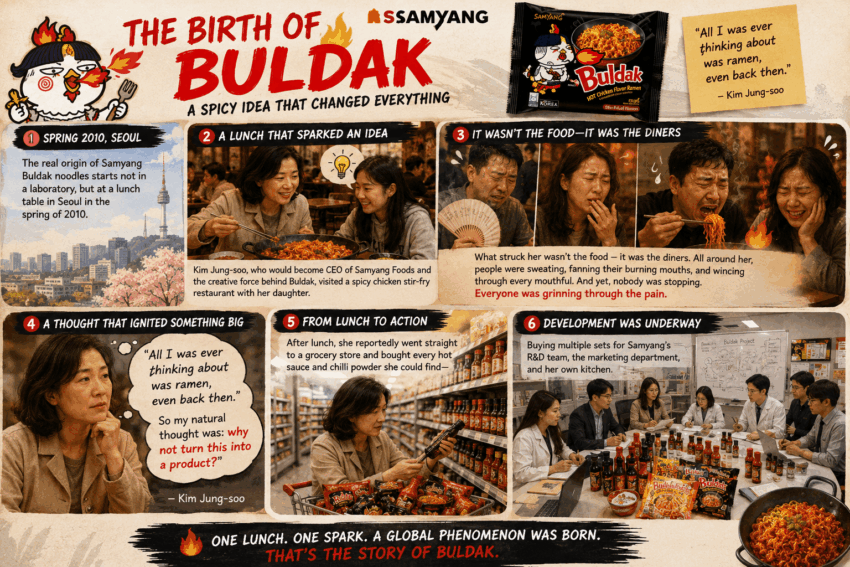
The real origin of Samyang Buldak noodles starts not in a laboratory, but at a lunch table in Seoul in the spring of 2010.
Kim Jung-soo, who would become CEO of Samyang Foods and the creative force behind Buldak, visited a spicy chicken stir-fry restaurant with her daughter. What struck her wasn’t the food — it was the diners. All around her, people were sweating, fanning their burning mouths, and wincing through every mouthful. And yet, nobody was stopping. Everyone was grinning through the pain.
“All I was ever thinking about was ramen, even back then,” she later told journalists. “So my natural thought was: why not turn this into a product?”
After lunch, she reportedly went straight to a grocery store and bought every hot sauce and chilli powder she could find — buying multiple sets for Samyang’s R&D team, the marketing department, and her own kitchen. Development was underway.
Two Tonnes of Sauce and 1,200 Chickens
Creating Buldak was no overnight project. Samyang’s food scientists worked through roughly 1,200 chickens and two tonnes of sauce in the development process, testing chilli peppers sourced from around the world. Kim reportedly kept pushing the team to make it spicier, past the point where it felt commercially sensible.
Chief food scientist Lee Byung-hoon later recalled his reaction to the final product: “She’s actually going to sell this?”
She was. Hot Chicken Flavor Ramen — the first Samyang Buldak noodle — launched on 4 April 2012, in its now-iconic black-and-red packet, featuring a cartoon fire-breathing chicken mascot named Hochi. The original recipe clocks in at 4,404 Scoville Heat Units (SHU) — comparable to a hot jalapeño, but delivered in a thick, oil-based sauce that clings to your mouth and refuses to let go.
Initial sales were… underwhelming. Retailers and early customers largely said the same thing: it’s just too hot. In South Korea, the buldak restaurant trend had already peaked around 2006 and was fading. Samyang appeared to have bet big on a concept the market had moved on from.
And then the internet got involved.
The Fire Noodle Challenge: How Buldak Conquered the World
The Video That Started It All
In February 2014, a British YouTube channel called Korean Englishman posted a video with a wonderfully simple concept: hand a bowl of Samyang’s terrifyingly spicy fire noodles to ordinary British people — including the presenter’s own father — tell them they cannot drink water, and film what happens.
The video racked up millions of views. Viewers watching people gasp, sweat, abandon the table, and immediately return for another forkful were transfixed. The #FireNoodleChallenge was born, and hundreds of thousands of copycat videos followed across YouTube, and later TikTok and Instagram.
Matt Stonie and 151 Million Views
The challenge format eventually reached American competitive eating champion Matt Stonie, who in July 2019 uploaded a video of himself eating fifteen packs of Buldak in a single sitting. That video has gone on to accumulate roughly 151 million views — making it one of the most-watched food videos in YouTube history, and doing more for Samyang’s international sales than any marketing campaign could have achieved.
K-pop culture amplified things further. As Korean pop music and drama became a global phenomenon through the 2010s, anything connected to Korean culture — food included — got pulled into the same orbit. Buldak became shorthand for authentically Korean, adventurous, and shareable. Celebrities were spotted eating it. Unboxing channels were dedicated to it. Fans were hunting it down in Asian supermarkets worldwide.
Grammy-winning rapper Cardi B once publicly admitted she drove 30 minutes just to track down a stash of Samyang Buldak noodles. You genuinely cannot pay for that kind of promotion.
Crucially, Samyang spent nothing to make any of this happen. The entire global explosion of Buldak was organic — driven entirely by people wanting to share the experience of suffering through the world’s most aggressively spicy noodle.
The Buldak Flavour Universe: Something for Every Heat Threshold
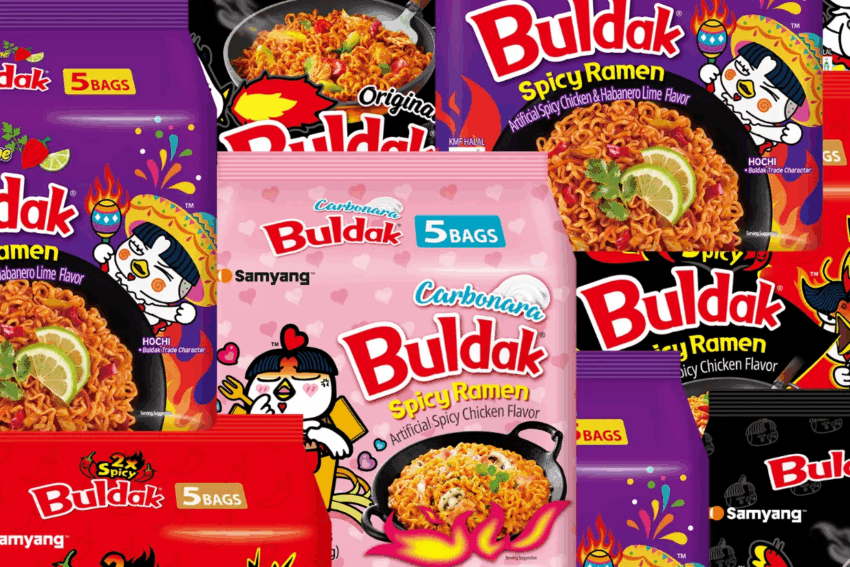
What started as one product in 2012 has grown into one of the most diverse instant noodle lines on the planet. Today, Samyang Buldak noodles come in roughly 16 active flavours, ranging from creamy and mild all the way to genuinely alarming.
Here’s a quick guide to where they sit on the heat scale:
| Flavour | Scoville (SHU) | Heat Level |
| Carbonara | ~2,600 | 🔥 Mild |
| Cheese | ~2,323 | 🔥 Mild |
| Jjajang | ~1,920 | 🔥 Mild |
| Curry | ~3,810 | 🔥🔥 Medium |
| Original | 4,404 | 🔥🔥 Medium-Hot |
| 2x Spicy | ~8,808 | 🔥🔥🔥 Hot |
| 3x Spicy | ~13,200 | 🔥🔥🔥🔥 Extreme |
The Carbonara variant deserves a special mention — launched in January 2018 to celebrate one billion packs sold, it quickly became one of the most popular Buldak flavours globally. The creamy, cheesy sauce cuts the heat enough to make it genuinely accessible, which is probably why it’s often the gateway Buldak for people who want the experience without the full consequences.
At the other end of the spectrum, the 3x Spicy variant achieved the remarkable distinction of being recalled by Denmark in 2024 for being too hot — with Danish authorities citing concerns over capsaicin levels. Denmark eventually re-assessed and maintained the ban only on the 3x Spicy, while reinstating the 2x Spicy and Stew Type variants. For a noodle brand, being too spicy for a European government is arguably the best press coverage imaginable.
Beyond noodles, Samyang has extended Buldak into a full universe of products: bottled hot sauce (exported to over 50 countries), tteokbokki, dumplings, snacks, and more.
The Numbers: Just How Big Is Buldak?
In case you needed convincing that Samyang Buldak noodles are a genuine global phenomenon, here are the numbers:
🔥 1 billion packs sold by end of 2017
🔥 4 billion cumulative packs by August 2022
🔥 7 billion packs sold by end of 2024
🔥 8 billion packs sold by the first half of 2025 alone
🔥 100+ countries now receive Buldak exports
🔥 1 trillion Korean won in exports exceeded for the first time in 2024
Samyang’s Buldak now accounts for roughly 75–77% of the company’s total sales. The product that retailers initially said was too spicy to sell is now the entire engine of a company that crossed the “2 Trillion Won Club” in overseas sales revenue in 2025.
As for CEO Kim Jung-soo, whose lunch in 2010 kicked all of this off — she and her husband appeared on Forbes Korea’s 50 Richest list in 2025, ranked 21st with a combined net worth of $1.3 billion. Not bad for a bowl of noodles that nearly nobody wanted to buy.
Want to Try Every Samyang Buldak Flavour?
If reading all of this has made you want to work your way through the Buldak flavour lineup — from the gateway comfort of Carbonara to the reckless ambition of 3x Spicy — we’ve got you covered.
At Oisoy, we curate the best Korean and Asian snacks and noodles, including Samyang products, delivered straight to your door. Whether you want to pick individual packs or commit to a regular snack habit, there’s an option for you:
→ Subscribe and save with our Asian Snack Box subscription — new flavours, snacks and noodles curated monthly.
→ Prefer a one-time order? Browse our full Asian snack selection here — no commitment needed.
Whether you’re a Buldak veteran who eats 2x Spicy without breaking a sweat, or someone who’s only just discovered the beautiful chaos of fire chicken noodles, there’s never been a better time to explore the full lineup. Your taste buds will thank you. Eventually.

The Bottom Line
Samyang Buldak noodles are one of the most remarkable product stories in modern food. A company struggling for relevance, a CEO who couldn’t stop thinking about ramen, a dangerous lunch, two tonnes of sauce, and a cartoon fire chicken. Then a few years of silence, one viral video, and suddenly: global domination.
The next time you hold a packet of Samyang Buldak noodles — in all their glossy, threatening, red-sauce glory — remember that behind it is a woman who looked at a room full of people sweating through their meal and thought, “I want to bottle that.” And then did exactly that. Eight billion times over.